


Custom Seal 235×275 mm for a TA Luft-Relevant Application
Initial Situation
In an industrial tumbling dryer, an existing gland packing was to be replaced by a defined sealing system. The objective was to improve sealing performance, reduce maintenance effort and increase operational reliability.
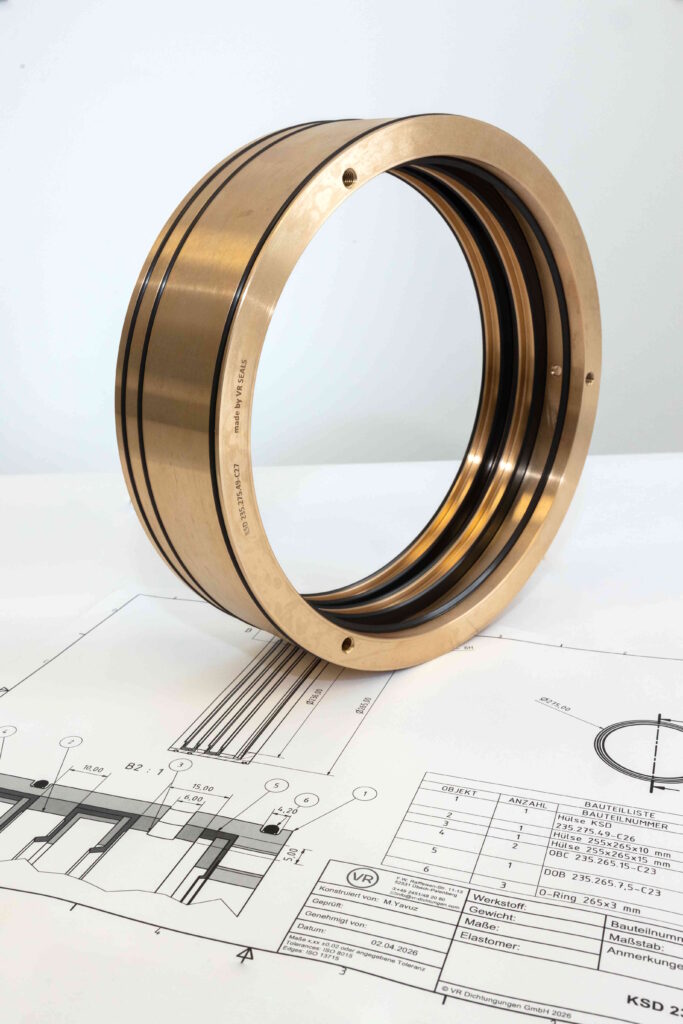
Operating data of the sealing point:
| Parameter | Value |
|---|---|
| Machine | Industrial tumbling dryer |
| Task | Replacement of gland packing |
| Seal size | 235/275 mm in this case |
| Temperature | 160–200 °C |
| Pressure | 3–3.5 bar |
| Speed | 6–12 min⁻¹ |
| Circumferential speed at Ø 235 mm | approx. 0.07–0.15 m/s |
| Regulatory context | TA Luft-relevant sealing point |
TA Luft refers to the German Technical Instructions on Air Quality Control. It is not a medium or material specification, but a regulatory framework defining air pollution control requirements for industrial plants.
Technical Assessment of the Sealing Point
The shaft speed is low. Therefore, the main design challenge is not circumferential speed or frictional power, but the combination of:
- operating temperature up to 200 °C
- pressure load up to 3.5 bar
- large seal diameter
- possible gas or vapour phase
- requirement to reduce fugitive emissions
- replacement of an adjustable packing by a geometrically defined sealing system
For agitators operating in the gas or vapour phase of pressurised vessels, TA Luft refers to sealing systems with low leakage losses, multi-chamber lip seal systems or equivalent technically tight systems. The tumbling dryer is not a classical agitator, but the sealing task is comparable: rotating shaft penetration, pressure, temperature and emission-relevant sealing.
Seal Concept
A custom seal in size 235/375 mm was designed for this application.
Design approach:
- multi-lip sealing system instead of gland packing
- machined metallic support body
- defined seal gap to limit gap extrusion
- high-temperature elastomer matched to temperature and medium
- static sealing against the housing
- optional grease or barrier chamber depending on machine design
The seal was not selected as a standard catalogue item. It was engineered based on the actual operating data and installation geometry.
Key Design Points
1. Temperature
At 160–200 °C, standard NBR is not suitable. Depending on the medium and chemical exposure, suitable materials may include FKM, VMQ or FFKM.
The final material selection must consider not only temperature, but also process vapours, oxygen exposure, cleaning agents, dry-running phases and lubrication conditions.
2. Pressure
3.5 bar corresponds to approx. 0.35 MPa. This pressure level is manageable with a correctly designed radial shaft sealing system.
The critical design factor is the support body diameter and the seal gap ds. Under pressure, the elastomer must be supported in such a way that gap extrusion is limited. For this reason, a machined support body is preferred over a simple stamped support component in this type of application.
3. Friction
Compared with conventional spring-loaded sealing elements, the VR sealing principle works with reduced radial force. Lower radial force reduces frictional load, heat generation and wear on the shaft surface.
This is particularly relevant when replacing gland packing, where sealing performance is usually achieved by axial compression of the packing rings.
4. Maintenance
Gland packing requires monitoring and adjustment during operation. Wear, compression loss and leakage behaviour can change over time.
The custom seal works with a defined lip geometry. The objective is a more stable operating condition with reduced adjustment and maintenance effort.
Result
The gland packing was replaced by a custom-designed seal for the given operating conditions.
Technical benefits:
- mechanical seal instead of compressed packing
- reduced frictional load on the shaft
- lower maintenance effort
- improved control of leakage paths
- suitable design approach for TA Luft-relevant sealing points
- adaptable to grease, flushing or barrier concepts
Conclusion
For industrial tumbling dryers, mixers, agitators and similar process equipment, replacing gland packing with a custom radial shaft seal can be technically advantageous when temperature, pressure and emission requirements are properly evaluated.
In this case, the central task was the engineering of a custom seal 235/275 mm for operation at 160–200 °C, 3–3.5 bar and 6–12 min⁻¹.